Enterprise Compliance & Traceability
Requirements System
B2B SaaS platform designed to modernize requirements management and traceability through an interactive matrix-based system and contextual drill-down interactions.
B2B SaaS • Compliance
Product Type & Domain
3 Months
Timeline
Web App • Angular
Platform
Context
Dokumentor is a B2B SaaS platform designed for product, QA, and compliance teams working with structured requirements documentation (SRS, STD, REQ).
The product was conceived as a modern alternative to tools like ReqView, Jama, and traditional Excel-based traceability matrices.
The goal was to build an MVP that simplifies requirement management and provides real-time visibility into test coverage and traceability.
I worked as the sole Product Designer in close collaboration with the founder.
The Problem
Teams working with requirements-heavy products often rely on:
Excel-based traceability matrices
Confluence documentation + manual linking
Static exports for audits
Disconnected test case tracking
This created several recurring issues:
Poor visibility into coverage (what’s tested vs what’s missing)
Manual linking between requirements and test cases
High risk of audit failures due to outdated or inconsistent documentation
Fragmented navigation across multiple pages and tools
No clear ownership or status visibility per requirement
In most cases, traceability became a compliance burden rather than a product insight tool.
The core problem wasn’t the lack of documentation —
it was the lack of structured, interactive, and real-time traceability.
My Role
I was the sole Product Designer responsible for:
Defining the information architecture
Designing the full requirements structure (Projects → Sections → Items)
Creating the traceability matrix logic and interactions
Designing requirement ↔ test case linking flows
Defining coverage states (Covered, Uncovered, Failed, Blocked, etc.)
Designing hover interactions, drill-down logic, and side-drawer views
Aligning product decisions directly with the founder
The challenge was not just UI — it was designing a coherent system for complex documentation workflows.
The Core Design Challenge
The most complex challenge was:
How to show maximum traceability insight on a single screen without overwhelming the user.
Traceability tools often force users to:
Open multiple tabs
Jump between requirement detail pages
Navigate separate test modules
Manually inspect coverage
I redesigned this by introducing:
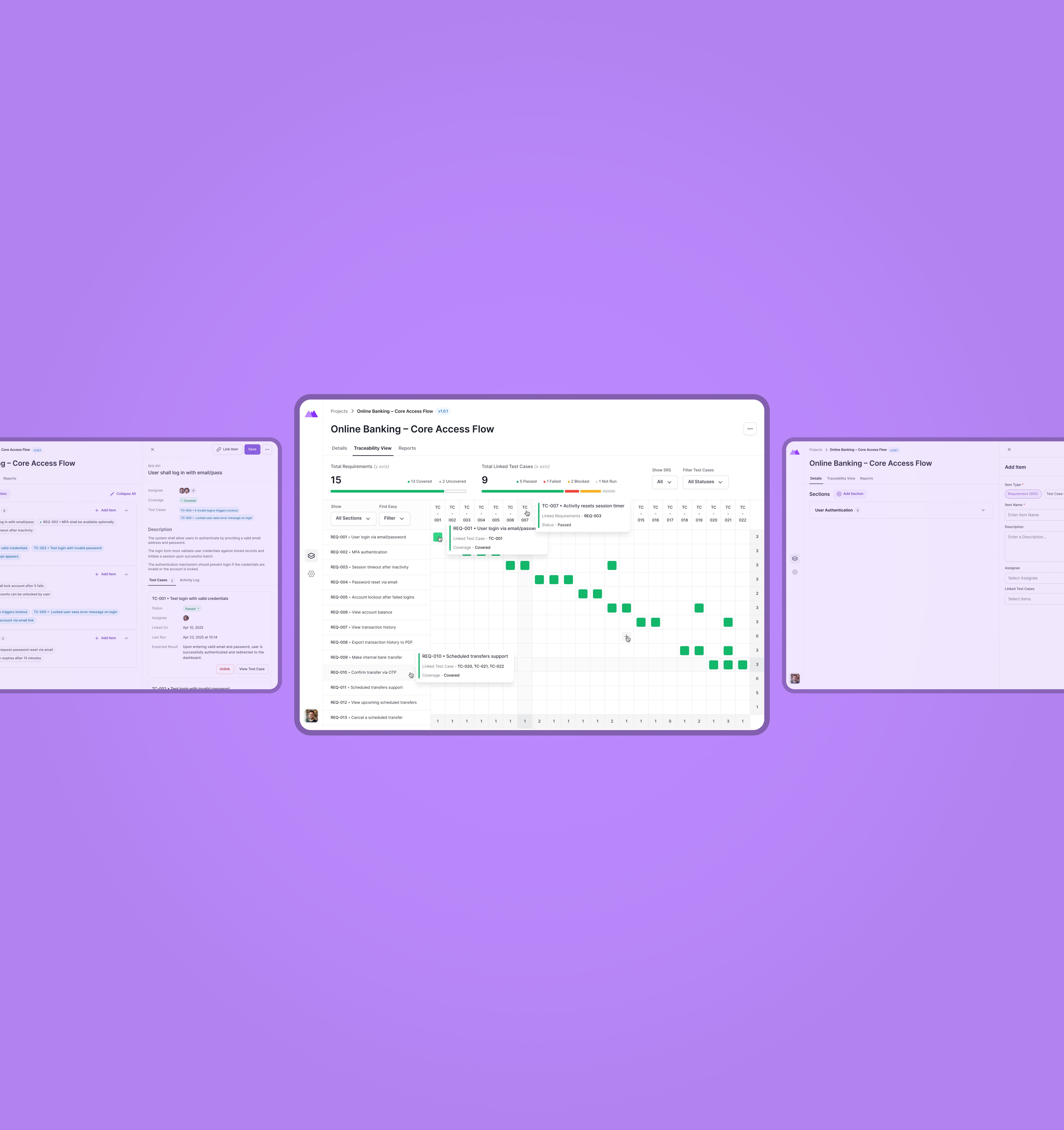
Interactive Traceability Matrix
Requirements on the Y-axis
Test cases on the X-axis
Real-time coverage visualization
Color-coded states
Hover tooltips with contextual information
Cell / row / column click drill-down via side drawer
Users could understand coverage gaps instantly — without leaving the page.
Contextual Side Drawer
Instead of page transitions, detailed views opened in a side panel:
Requirement details
Linked test cases
Coverage status
Activity logs
Linking / unlinking actions
This preserved context and eliminated navigation friction.
Structured Section-Based Architecture
Projects were structured as:
Projects → Sections → Items (REQ, SRS, STD)
This allowed:
Logical grouping of requirements
Clear ownership
Scalable documentation growth
Easier filtering and reporting

Outcome
The MVP successfully delivered:
A modern, interactive traceability experience
Real-time visual coverage overview
A cleaner alternative to spreadsheet-based workflows
A scalable structure for compliance-driven teams
While the product has not yet been released publicly, early feedback from potential users confirmed strong interest in:
The matrix visualization
Simplified linking behavior
Reduced audit preparation effort
What I Learned
Designing Dokumentor reinforced how critical information architecture and system thinking are in enterprise SaaS products.
It also emphasized that in complex tools, the goal is not adding more features — but reducing cognitive load while preserving data depth.
This project significantly strengthened my approach to designing high-density, data-heavy interfaces.
Next Projects